
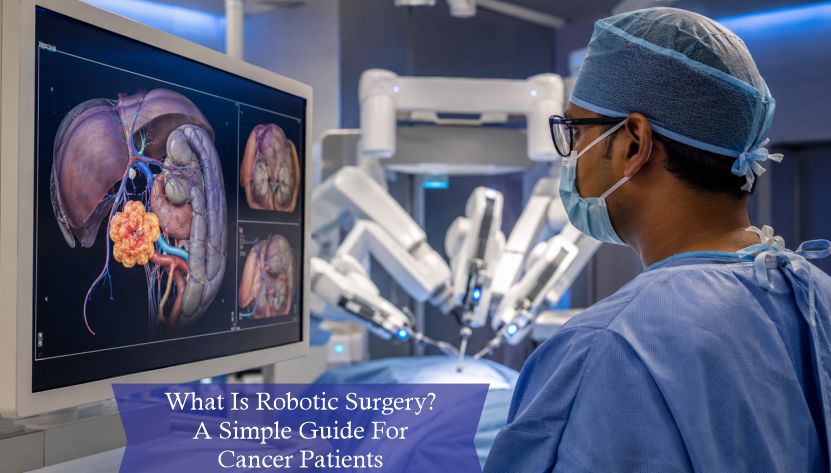
What is Robotic Surgery? A Simple Guide for Cancer Patients
If you or a loved one has been diagnosed with prostate cancer, kidney cancer, or bladder cancer, your doctor may have recommended "robotic surgery." For most patients, this raises an immediate question: What exactly is robotic surgery, and should I be worried?
The good news: robotic surgery is not science fiction. It is one of the most advanced, precise, and patient-friendly surgical approaches available today, and it has transformed outcomes for thousands of urological cancer patients.
This guide breaks it down simply so you know exactly what to expect.
What is Robotic Surgery?
Robotic-assisted surgery, also called robot-assisted laparoscopic surgery, is a minimally invasive surgical technique where the surgeon uses a robotic system to perform precise operations through tiny incisions.
The most widely used system is the da Vinci Surgical System. The surgeon sits at a console in the operating room, viewing a high-definition 3D image of the surgical site, and controls robotic arms that hold miniaturized surgical instruments inside the patient's body.
Important: The robot does not operate independently. The surgeon is fully in control at every moment.
How Does Robotic Surgery Work? Step by Step
Step 1: Small Incisions
Instead of one large cut, the surgeon makes 3 to 5 small incisions, each less than 1 cm. Through these, robotic arms and a camera are inserted.
Step 2: 3D Visualization
The camera provides a magnified, high-definition 3D view of the surgical area, far clearer than the human eye can see during open surgery.
Step 3: Precise Robotic Movements
The surgeon's hand movements are translated into smaller, finer movements by robotic instruments. This eliminates natural hand tremors and allows for exceptional precision in delicate areas.
Step 4: Completion and Closure
Once the procedure is complete, the instruments are removed and the tiny incisions are closed with sutures or surgical glue.
Which Cancer Surgeries Use the Robotic Approach?
Robotic surgery is now used across multiple urological cancer procedures, including:
- • Radical prostatectomy, removal of the prostate for prostate cancer
- • Partial nephrectomy, removal of part of the kidney while preserving healthy tissue
- • Radical nephrectomy, complete removal of the kidney for kidney cancer
- • Radical cystectomy, removal of the bladder for bladder cancer
- • Neo-bladder reconstruction, creating a new bladder using intestinal tissue
- • Lymph node dissection, removal of lymph nodes to check cancer spread
Robotic Surgery vs Open Surgery vs Laparoscopic Surgery
Here is a clear side-by-side comparison to help you understand the differences:
| Feature | Open Surgery | Laparoscopic Surgery | Robotic Surgery |
|---|---|---|---|
| Incision Size | Large, 10 to 15 cm | Small, 0.5 to 1 cm | Small, 0.5 to 1 cm |
| Surgeon View | Direct | 2D Camera | 3D HD Camera |
| Precision | Good | Good | Excellent |
| Hospital Stay | 5 to 7 Days | 2 to 3 Days | 1 to 2 Days |
| Recovery Time | 4 to 8 Weeks | 2 to 4 Weeks | 1 to 3 Weeks |
| Blood Loss | Higher | Lower | Lowest |
| Nerve Preservation | Moderate | Good | Best |
Benefits of Robotic Surgery for Cancer Patients
- • Less pain and discomfort after surgery
- • Significantly shorter hospital stays
- • Faster return to daily activities and work
- • Minimal scarring due to tiny incisions
- • Reduced risk of infection
- • Less blood loss and lower need for transfusions
- • Higher chance of preserving urinary control and sexual function, especially in prostate surgery
- • Greater surgical precision in tight anatomical spaces
Is Robotic Surgery Safe? Are There Any Risks?
Robotic surgery is considered extremely safe when performed by an experienced uro-oncologist. Like all surgeries, there are general risks such as bleeding, infection, or anesthesia reactions, but these are significantly lower compared to open surgery.
The key factor in safety is not just the technology. It is the surgeon's expertise and experience with the robotic platform. Always ask your surgeon how many robotic procedures they have performed.
What to Expect Before and After Robotic Surgery
Before Surgery
- • Preoperative blood tests and imaging
- • Anesthesia consultation
- • Bowel preparation for some procedures
- • Fasting as instructed
After Surgery
- • Most patients walk the same day or the next day
- • Catheter may be in place for 7 to 10 days for prostatectomy
- • Light diet initially, progressing to normal diet
- • Follow-up appointments to monitor recovery and pathology results
Frequently Asked Questions (FAQs)
Q1: Is the robot doing the surgery on its own?
No. The robotic system is entirely controlled by the surgeon. It is a tool that enhances precision, not an autonomous machine.
Q2: Does robotic surgery cost more than open surgery?
The upfront cost may be slightly higher, but when you factor in shorter hospital stay, faster recovery, and fewer complications, the overall value is excellent.
Q3: Is robotic surgery available for all cancer stages?
Robotic surgery is most effective in early to intermediate stages. Your surgeon will assess your specific case and cancer stage to determine the best approach.
Q4: How do I know if I am a candidate for robotic surgery?
A consultation with an experienced uro-oncologist will include imaging, biopsy results, and a full assessment to determine your eligibility.
Conclusion
Robotic surgery represents one of the greatest leaps forward in cancer treatment. For patients facing urological cancers, it offers the best of both worlds: the thoroughness of cancer-removing surgery with the comfort and speed of minimally invasive techniques.
If you or a loved one has been recommended robotic surgery, approach it with confidence, not fear. Ask questions, understand your options, and trust the expertise of your surgeon.
Contact Us
The Gujarat Uro Oncology Associates team offers expert consultation, diagnosis, second opinions, and treatment planning for urological cancers. To learn more or book an appointment, contact 91 75730 04253 or email bakshihemang@yahoo.co.in.